
TL;DR
- Purpose: Most of us were never formally taught how to read plain films, and we have predictable blind spots because of it. You have to take the initiative to learn how to do it yourself and developing a systematic approach to looking at films is the best place to start.
- First question to ask: Before radiology reads it, what do YOU see?
- Don’t miss: A posterior fat pad on an elbow film means effusion and occult fracture until proven otherwise. Snuffbox tenderness with a “negative” wrist film is a scaphoid fracture until proven otherwise, splint it and send to ortho. “Fluffiness” on a chest x-ray in a patient with fever and cough is probably pneumonia even if radiology reads it as normal.
- In the app: Blox has real images of common x-ray findings by topic (think posterior fat pads, subtle effusions, infiltrates, etc.), so you know what to look for.
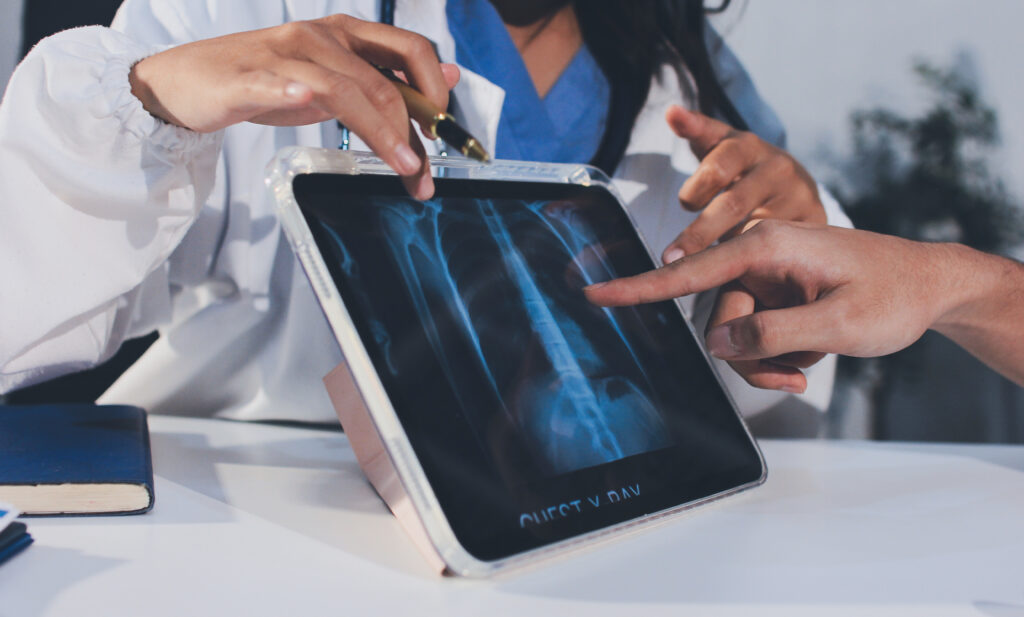
Reading x-rays is one of those skills most of us were never formally taught. Programs give you a cursory overview, maybe a few days of basic interpretation if you’re lucky, but nothing that actually sticks. You mostly just pick it up over time and hope radiology catches the big stuff in the meantime.
That’s not a reliable strategy, and it’s not good medicine. Radiology misses things all the time, and when you don’t have your own read, you’ll miss them too.
I had a patient I saw in urgent care a few years back. He was maybe nine or ten and had fallen on the playground during recess. His mom had already taken him to his pediatrician that morning, who sent him for x-rays, called her back, and said they didn’t see a fracture but to come back in a week if it was still bothering him. By dinner, he was still hurting enough that his mom felt something was off, so she brought him into our clinic.
I got repeat films and even though there was no obvious fracture, I found a small posterior fat pad. So I treated him as an occult fracture and referred to ortho. I got the follow-up note the next week that he had a nondisplaced lateral condyle fracture.
This is a perfect example of why it’s so important to have a systematic approach to reading plain films.
You Have to Have a System
Most of us can catch an obvious fracture, a pneumonia, or a pneumothorax. That’s not really the issue. The bigger problem is confirmation bias — your eye automatically goes to what you’re already looking for. A patient comes in with fifth metatarsal pain after rolling their ankle. Of course you check the fifth met, but if you don’t see a fracture it’s easy to just call it normal and move on. But what about the rest of the foot? What about the lateral malleolus? You can miss a lot when you have a singular focus going in.
Develop a systematic approach to every single plain film.
- For extremity films, start with the cortex of every bone on the image, then alignment, then soft tissue.
- For chest films, ABCs: airway, breathing, cardiac silhouette, diaphragm, effusion. It really doesn’t matter as much which approach you use as long as you use it the same way every time.
Read the Film Before Radiology Does
This is one of the most important habits to build, particularly if you’re new to practice. I know that it’s easy to pull the film up, look for something obvious, and then just wait for the formal read. The problem is you never actually build your skillset that way. You’re always seeing someone else’s interpretation before you’ve even taken the time to form your own.
Reading it yourself first means you’re working from what your exam actually told you (yet another reason to touch your patients). The radiologist doesn’t know your patient had point tenderness over the snuffbox or that the mechanism was a high-energy FOOSH or that your patient with a cough looks SICK, you do. That context matters. Radiology misses things all the time.
It also means you can catch things while the patient is still in the room. You don’t want to be the provider who sent a patient home with an untreated pneumonia because you were waiting on radiology to tell you what you could already see clinically.
Yes, the official read is still important and can help to inform your decision-making, but you should have something to say about the film before it comes back.
What Gets Missed
There was an analysis published in Acta Radiologica that found two thirds of missed fractures were visible on the original plain film. Eek.
Here’s what tends to get missed:
- Posterior fat pads. A visible posterior fat pad on an elbow film after trauma means there’s a joint effusion, and effusion after trauma means fracture until proven otherwise. The fat pad sign is about 75 to 85% sensitive for occult fractures.
- Snuffbox tenderness with a normal wrist film. Up to 40% of scaphoid fractures are missed at the first visit because plain films are poor at picking them up right after injury. Tenderness over the snuffbox after a FOOSH is a scaphoid fracture until proven otherwise. Splint it and refer to ortho (or reimage in 10-14 days).
- Subtle chest x-ray findings: A little “fluffiness” in the right lower lobe in a patient with a productive cough and a fever is pneumonia until proven otherwise, even if the radiologist reads it as ‘no acute cardiopulmonary process.’
When the Film and the Exam Don’t Agree
Trust your exam. If your patient has point tenderness over bone, swelling, and a mechanism that fits, treat them as a fracture. It doesn’t matter if they have a “normal” x-ray.
Document your reasoning either way: “Film negative for acute fracture, point tenderness present over the anatomical snuffbox in the setting of a FOOSH, patient splinted in thumb spica, follow up for repeat imaging in 10 days.”
Same goes for chest films. A subtle infiltrate (or “schmutz” if you’re fancy like me) in a patient with a productive cough and a fever is still pneumonia even if the radiologist calls it normal. An effusion that’s easy to miss on a portable AP film is still an effusion. If the clinical picture and the imaging don’t match up, the clinical picture wins.
One thing that actually helps with pattern recognition: seeing what these things look like in real life. Blox includes real images of these findings by topic, so you can see a posterior fat pad, a subtle effusion, or a Lisfranc injury on actual films. Try it for free here.